Tuesday, September 5, 2017

Where, Exactly, is Over Yonder?!!?

My Grandmother and Granddaddy lived within hollerin’ distance of us.  There was only a big field between the two houses.  We could stand in the back yard and holler at them to say hi, or get a short message to them.  My cousins lived just a hop, skip and a jump from us (at the bottom of the hill), and our church was just over yonder a ways (down at the end of the road, more or less).  We had other cousins that lived “so far out that they have to pump in sunshine”.  They lived “on the back side of never”, “way out in the boonies”.  “You’ll think you’re lost” more than once, if you try to get there.  We live “out past the country line” (in the rural South), “just a hoot n’ a holler” out past the fork in the road where Payne’s Store usta be. 
We Southerners have our own unique ways of defining space as it pertains to where a place is located.  Some are unique phrases only heard in the South, and some are directions based on where commonly known landmarks are… well common to those in the area anyway.  We understand the directions, but those not familiar with these “special explanations” are often left more confused than before they asked.  Of course, in today’s world of GPS’s on every phone, it’s not as big a deal as it used to be, but back in the day, folks either knew where places were, asked for directions, or had a glove box fulla maps for one place or another. 

When using the word “yonder”, we usually accompany that with the pointing of a finger so that the general direction is known (even though pointing isn’t considered to be polite).  “Way down yonder” (or “way up yonder”) is a considerably longer distance than just “over yonder”.   The down and up sometimes equate to compass directions but not necessarily so.  “Out past the country line” just meant that it was out past the point where city dwelling switched over to wide fields and country houses surrounded by gardens and pastures.  “Just a stone’s throw away” is a shorter distance than “a hop, skip, and a jump” usually, but is generally assumed to be much longer than what one could actually throw a rock.  When I was a kid, and first heard the expression “a stone’s throw away”, I thought that meant that I needed to go out in the field and throw rocks ‘til I had a pretty good idea of how far that was.  I was pretty good at throwing rocks (and softballs and such) back in the day, so it might have been a pretty good distance.   Turns out, that wudn’t it at all. 

Then there are the directions that are dependent on landmarks of one kind or another.  Stop and ask a Southerner (we’ll call him JimBob) for directions around here and you’d hear something like this:  “Go down that road ‘til you come to a fork where the crooked silo sits.  It’s just about to fall over.  You can’t miss it.  If you come to the Shell station, you’ve gone too far.  Or is it a Citgo?  Yeah, I think it’s a Citgo nowadays.  Just a piece down that road you’ll see that old barn that looks like it’s smilin’ at ya.  Past that is the church.  When you go past the graveyard, take the second left.  The Jenkins’ house is on the right down that way.  There’ll be a row of scrawny pine trees right next to the house.  Should see a broke Chevy pickup in the front yard, up on blocks.  Charlie’s been workin’ on that thang lately. “  The conversation will likely go on from there as he tells you about how he was helping Charlie the other day and they had to end up rebuilding the carburetor, or some such thingamajig.  Hope you turned the car off before you asked directions because JimBob is liable to be awhile before he winds down.  Directions are more of a stream of consciousness sort of thing with us Southern Folk, rather than step by step instructions.  There’s a special skill in listening to those sorts of directions and then actually being able to follow them afterward.  Most folks make the mistake of trying to repeat those directions back to make sure they got them right.  What’s sure to ensue is that good ol’ JimBob is going to have thought of a “better way” to get you there by that time, and will be only too glad to share that with you. 

Here’s something else you should know… be aware of what you’re asking for if you go up to a whole group of Southerners and ask for directions… or if you’re just visiting with folks and happen to mention that you don’t know a good way to get to “somewhere”.    Each will have his/her own way of getting there, and are all too willing to tell you just why their way is better than someone else’s.  And don’t even try to tell them that you just go whichever way Google Maps tells you to go because the given assumption is that there’s no way that Google, or any other map/GPS service, knows ALL the cut-through back country roads that will save you ever so much time if only you’d pay attention to what they are telling you.  “Besides, the countryside is so pretty this time of year.”  If you find that you’ve stumbled into this situation, it’s best to just listen and nod, then thank them all for sharing their wisdom.  For heaven sake, don’t try to repeat what they told ya, or you may never git home. 

So whether you’re goin’ down the road a piece, takin’ a ride over yonder, or visiting Great Aunt Sally that you haven’t seen in a coon’s age… you might want to rely on your GPS… unless you’ve got time to c’mon in and sat a spell, have a glass of sweet tea, and we’ll all tell ya the best way to git there frum here.

Fer now, I gotta skedaddle.  Me ‘n’ Mama ‘n’ nem are goin’ to the Grill.  It’s just down the road a piece, out past the church.  You know where the road dips down into that “kiss me quick”?  Well it’s on past that a little bit.  Kain’t miss it.  Did you know that the church put up a new play ground a week or so ago?  It looks real nice.  Coulda used more shade trees near it though……………
 

Ya’ll come back now, ya hear?!!


Saturday, August 19, 2017

Learnin' to Step 'Tween the Raindrops

People in the country are obsessed with rain... and understandably so.  Life depends on water... gardens can’t grow without it, animals (and people) need it to drink, and for goodness sake, we can’t have the fishin’ hole dryin’ up because there hasn’t been enough rain.  It’s something we count (inches), and count on, out here in the country.  If we don’t get enough of it, things can get bad real quick.  We grow what we eat.  No rain means substitutions (irrigation, hauling water to the animals, etc.) have to be made somehow before the garden starts to die.

We have "dry spells" here at times, especially as the sweltering heat of the summer move into the dog days of August.  The weeks are filled with hot, humid days with no rain in sight, temps soaring to the tiptop of the thermometer, day after day after steamy day.  Gardens that had bumper crops all summer start drying up.  Yards became dust bowls when mowers cross them.  Even the butterflies slowly disappeared for the year.  Then the cooler temps and the rain returned.  The hummingbirds dance in the raindrops, washing the dust from their glimmering feathers.  The birds sang happily in the trees, and you could almost hear the grass in the yard sighing a long, low "Ahhhhhhh".  The cooler temps will eventually allow for open windows and fresh breezes wafting through the house.  Everything looks greener... and happier somehow.

A farmer or gardener plans their days around the rain.  Rain is a double-edged sword to them.  It’s needed for growing things, but too much can keep them out of the fields and gardens.  Gardeners can practically hear the raindrops seeping through the ground to their green beans and corn and squash.  They can also “hear” the weeds growing, and if it gets too wet in this red clay country we live in our here, tractors and such can get stuck up to their axles pretty easy.  So it’s a balance they are constantly wanting... just enough rain, but not too much. 

Of course, back when we were kids, rain meant a totally different thing.  It meant playing in the rain (when there was no thunder and lightning), splashing in the puddles, and making “mud pies”.  Frogs often came out in the rain, so there were those to chase and catch (and put back down before they “wet” your hand).  Rain coats?  Nope... only if you were going somewhere, like church or school.  We'd come back in soaking wet, head to toe, and happier for it.  It was like the rain brought with it another world, another reality of sorts, full of things to see and explore.  Even the raindrops stuck to leaves became sparkling jewels of shimmering light.   Getting wet was the whole point of the thing, not something to be tiptoed around and avoided.  Daddy got no end of pleasure out of waiting for one of us to walk under a tree, then he'd shake it really hard and cause all the stuck raindrops to fall down on us.  We’d run away screaming and laughing, because it was one thing to wet yourself with hose or rain or something, but quite another to be showered on unexpectedly.
My Grandmother Berteen always had a sayin’ about everything, and rain was no exception.  When we’d be dashing from house to car, or car to store, with the rain just pouring down around us... she’d always tell me that the trick to not getting wet was actually very simple.  You just stepped between the raindrops.  It seemed completely possible to me at the time, so I’d always give that some thought every time I was out in the rain.  I never have perfected the art of “stepping between the raindrops”, but I continue to try. 

When I think about rainy days, I always remember our summer family camping trips.  Reams of heavy duty clear plastic were always strung from the trees over the campsites to create a canopy for those rainy days.  We always knew it would rain sometime before we finished our week or so camping, so this was just part of setting up the campsite.  Up the tents would go, then came the plastic canopy.  Only then were other things unpacked and put into place.  It was the job of us kids to take the broom, on rainy days, and "sweep" the underneath of the plastic where the puddles of water were forming, to keep it drained off.  If you timed it "just so", you could splash a cousin or sister or someone.  Laughter followed... well, for everyone but the one being splashed.  I imagine keeping all us kids (sister, brother, plenty of cousins) entertained during rainy days was quite the chore for Mom and Dad.  As for the adults, this was when the card games came out, and you'd find clusters of them here and there, huddled around some picnic table or other, in the dry, playing cards and laughing about something or other. 

Sand is a hard thing to keep out of tents when camping at the beach, but wet sand... that was impossible to keep out of them.  And then there was the problem of tents leaking.  If the tents had been properly waterproofed before the trip, aaaaand if the covering of plastic over the tent hadn't blown up at a corner by the wind during the storm, you just might be able to keep dry.  Stay away from the edges though... don't touch the canvas of the tent.  That would cause the dreaded drip - drip - drip of rain to be able to get through the canvas, wetting beds, clothes, and anything else.  Nothing was quite as horrible as waking up in a puddle of wet blankets and beds.... but it always happened to someone.  It always seemed like magic to me how the rain would stay out if I didn't touch it, but came in if I did. Yes, I confess, the curiosity in me made me touch that forbidden canvas sometimes, haha.

Some people really love rain... it brings on thoughts of cuddling up with a warm blanket, a good book and a warm cup of coffee, tea, or hot chocolate.  It is, to some, the most soothing sound to fall asleep by.  It's often seen as an inspiration to those going through difficulties (... dancing in the rain... ), and restful to those whose busy days are forced to slow down because of it.  To some, however, raindrops are the tears of the Earth itself... an outward sign of inward pain... the grey of the skies painting a picture of the very soul.  Rain is written about in the Bible.  It’s used in novels to often cast a grim and dismal scene in vivid description.  It’s used in songs and poetry.  It is something that everyone can relate to in some way or another.

Whether you love it, hate it, or just see it as an important part of the very stuff of life itself... rain seems to draw as many emotional responses as the sunshine, or snow, or wind does.  It has inspired many songs, both comforted and depressed folks at different times, and is the very essence of life itself on this big blue marble we all live on. 

Are you humming “I Love a Rainy Night”, “Rainy Night in Georgia”, “Singing in the Rain” or “Rainy Days and Mondays Always Bring Me Down”.... or maybe some other song? 


“Man, despite his artistic pretensions, 
his sophistication and many accomplishments,
 owes the fact of his existence 
to a six-inch layer of topsoil 
and the fact that it rains.”


Tuesday, July 25, 2017

Green Stamps & Dishes in Detergent

60s Grocery Store Ad
Back when I was growing up in the 50's and 60's, we didn't have two nickels to rub together most of the time (as the saying goes).  The odd thing about childhood and memories is that I never realized that we, like everyone in our countryside community, had to save money any way we could.  Somehow Mom and Dad always made do, and we had everything we needed and most of the things we wanted.  I remember it as a happy time... a carefree time.... and things just were the way that they were.  Mom was a "stay at home Mom" (like the vast majority of housewives in our rural area in those days) and would make our clothes, cooked, cleaned, planted the flower gardens, helped out at the church, and did all sorts of crafty things.  Dad went to work every weekday, grew a garden every year, and was "handy" around the house when it came to fixing just about anything. I was the oldest, so I got the new dress that Momma made, and then my sister wore the hand-me-downs (she got new homemade outfits sometimes too, but was the chief benefactor of all the hand-me-downs).  Old clothes were used for things like quilts and rag rugs (after the buttons were cut off and saved, of course).  Nothing was wasted.  We just made do with what we had, and were happy in the doing of it.  We were just like everyone else we knew… wages were low, compared to today's standards, but then so were the prices of things.  Still, no one had "extra", so we got by best we could.  Fortunately, there were ways to be savin' about things back in those days.  Merchants even used the mind-set and way of life to bring people into their businesses... using marketing campaigns designed especially to entice those who had very little money to spend. 

Everyone saved S&H Green Stamps when I was growin' up.  The stamps came from the grocery stores, gas stations, and department stores, in exchange for buying groceries, gas or merchandise there (so says Wikipedia…. I only remember getting them at the grocery store).  It was often my job to put the stamps in the collector's book (about the size of a checkbook with boxes on each page for placement of stamps).It was often my job to put the stamps in the collector's book (about the size of a checkbook with boxes on each page for placement of stamps).  I can still remember how the glue on the back of the stamps tasted when I'd lick 'em and stick 'em.  (UCK!) Once you saved up multiple books of stamps, you could cash them in for household goods of one sort or another at the Green Stamp Store, or through the catalog (that was as commonly found in a home as the phone book). 

Mom and Dad once got a square card table with a dark green oil cloth covering on the top, along with four matching folding chairs from Green Stamps we saved.  That card table was used a lot.  It came out every time we had a family gathering… the men folk would sit around it and play Rook (our family's favorite card game) after the meal was served, while the women folk cleaned up the dishes in the kitchen.  That card table came out every New Year's Eve and held a jigsaw puzzle that we'd put together while we watched TV and waited for the ball to drop on Time Square.  It was brought out when we needed a few more places for people to sit when we had company over for meals. 

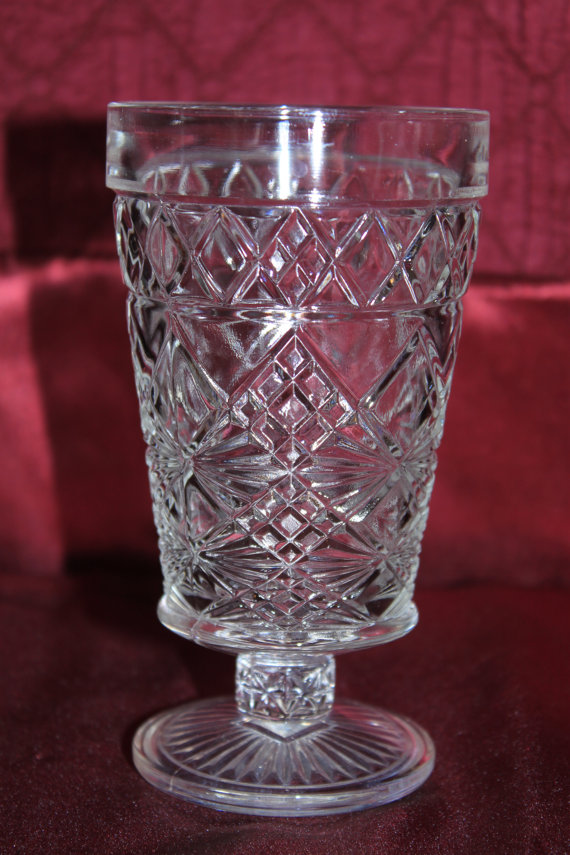
Green Stamps weren't the only thing that was collected though.  Many products came with things like dishes, glasses and/or silverware if you bought their brand over any of the others.  Skippy Peanut butter and Welch's Jelly often came in decorative "jars" that could be used as glasses once they were emptied and cleaned.  Sometimes they were fancy cut glass stemware, and other times they had cartoon characters printed on them (for the kids).  If you were lucky, you could find the milk glass ones… always one of my favs.  Glasses and dishes of all sorts came in things like powdered laundry detergent (Duz and Fab were two that put dishes in theirs).  It was very likely that you remember seeing some of the wheat pattern dishes in kitchens you were in growing up.  Glasses of all sizes came in Quaker Oatmeal boxes depending on whether you got the big box or the smaller box.  At my Grandmother's pharmacy, Tar Heel Drugs, if you bought a certain amount of medicine there, you could get silverware.  She ended up collecting enough to give each granddaughter a set of silverware when they got married.  The products were always something you'd be buying anyway (peanut butter, jelly, laundry detergent, etc.), so the glasses and dishes were just incentive to buy that brand over another. 

I still have some of the cut glass looking glasses, and the silverware Grandmother got me.  I remember seeing the wheat pattern dishes in Grandmother's dishes.  The oatmeal box glasses were a smokey color, and a few are still around in our kitchen cabinets today.  They hold memories as much as they are a practical item to have around.


I think back to those times and can't help but think how horrified people today would be to open a box of oatmeal and find a glass in it.  Even if the glass wasn't broken (and I never remember that we found broken dishes or glasses in those things) would they dare to use the product.  We've become too sanitized in our thinking and expectations, compared to back in the day.  Back then, we were just glad to find ways to save money.  If something was being offered along with products we would normally buy anyway, then it was a win-win.  It was a different mind-set back then.  It was a harder time, but a kinder time.  It's no wonder we get lost in nostalgia, wishing to go back instead of forward, sometimes. 

(Keep scrolling for a few more pictures of the dishes, glasses, and stamps of that era.)


Duz Detergent Dishes

Detergent Glasses

Peanut Butter Glass

Jelly Glass

Peanut Butter Glass
(Milk Glass)

Jelly Glass

1968 Green Stamp Catalog

Green Stamp Book with Stamps added

Green Stamps
  
S&H Green Stamp Store (circa 50's)


Tuesday, July 18, 2017

Dryin' Apples & Fried Apple Pies

Back in the my Grandmother's day, food didn't come from a grocery store. You grew your own, or grew/made something that could be used for barter with those who did grow their own. These days we just drive to the store, and go shopping. Most of the time though, the flavor of store bought fruits and vegetables isn't the same as those that were home grown. So, for that reason (and the organic craze), today we're seeing a revival of growing your own food. Back in the day, though, it wasn't an option... you grew your own or you didn't eat. And once it was grown you needed to preserve it some way. Today's options are freezing, canning, or dehydrating (drying). In the years before electricity, freezing wasn't an option.  Today we can things, freeze things, and dehydrate things… depending on which is best for what we want to use the produce for in the coming days and months.

We've always had fruit trees growing around us.  When I was a kid, Dad planted all sorts… cherry, damson, plum, and apple…….. All sorts of apple trees.  Apples are ready for the pickin' from early summer through Fall… and we seem to have some of every type here on our small farm.  The early apples are the best for applesauce.  The summer apples are good for chunking up and freezing for stewed apples later this winter.  Fall apples are good for pies, so those are chunked and frozen for those.  But there's only just so much that you can use over one wintertime (or sometimes two, depending on the bounty of the crop that year)… so what do you do with the rest?  Well, you dry them, of course. 

Back when Mom was a kid, that meant peeling, coring, and slicing by hand.  Then a sheet was spread out on the roof of the well (yes, the kind you draw water up with a bucket).  The slices of apple were spread out in the sun to dry.  If it rained, that meant running outside and gathering up sheet, apples and all, really quick.  After the rain, or perhaps the next day, the sheet was spread out again and the apples laid out to finish drying.  On a hot summer day, it wouldn't take long… just a day or two.  They were then gathered up and finished off in the oven to kill any bugs that might have gotten on them.  Sometimes she would spread a sheet out in the attic and dry them there.  I can still remember how it smelled upstairs when she had a lot of them drying.  The scent of apples everywhere.  Once they were dry to the point of still pliable but almost crispy, she'd put them an old cloth sugar or flour sack (back in those days things like sugar, flour and feed for the animals came in clothe sacks, not paper or plastic… those were saved and repurposed, but that's a story for another day).  As time went by, she moved to those square thick plastic freezer cartons and stored them in the freezer.  But the method of drying stayed the same for many years.  It wasn't until a couple of decades ago that that changed.

Today we use a dehydrator, and we even have a device that will strip the apple off the core in one continuous spiral slice (well that's the theory anyway… it seldom "works as intended" because apples aren't all the same size and symmetrically shaped, etc.).  Sometimes, though, we still sit and peel them by hand, slice chunks off the core, then slice them in thin slices.  Depends on how many apples we need to do at one time, as to which method is used.  Once they are sliced, we lay them on the trays that fit into the dehydrator… as many as will fit on a tray without laying one on top of the other.  24 hours later, they are dry but still pliable.  Those are gathered up into freezer bags and put into the freezer for later use.  You can put them all down into one big plastic bag, or portion them into smaller ones…. either way is fine.

Then, come winter…. It's time for some Fried Apple Pies.  Now for the novice that has never tried these handfuls of heavenly delight, these look very similar to those fruit pies that you can buy for a buck at the Dollar Store or the corner Quick Mart.  The difference is the taste…. I mean, com'on… doesn't homemade almost always taste better than store bought anything?! 

Start by getting out some of those dried apples out of the freezer.  Drop them into a sauce pan (about a double handful) along with about twice as much water.  Into that had the goodness…. sugar, cinnamon, maybe a touch of nutmeg… all the spices you'd think of when making an apple pie.  Simmer all those together until they make a thick goo.  You want the spices to be heavier than an apple pie because all you'll use is a heaping tablespoon per pie.  Now here's where most folks nowadays cheat a little…  Back in the day, you had to make dough, as if you were making a cross between pie crust and biscuits, while the apples were cooking down.  Nowadays, most folks just use canned biscuits.  Honestly, the taste isn't that different, and it saves a lot of time.  Each "biscuit" amount of dough is rolled out flat, and should be roughly the size of a saucer or dessert plate.  Have a small dish of water handy.  Place a heaping tablespoon of the apple goo into the center.  Fold the dough in half, and use the water to wet the edge to seal.  A fork dipped in flour and pressed around the edge finishes the seal.  Pop those in a frying pan that's coated in veg or canola oil and fry to brown on both sides.  Once browned, remove from pan, and finish any way you choose.  Some people leave them as they are, some sprinkle them with confectioner's sugar, and others take them straight from the pan and roll them in a sugar/cinnamon mixture.  Whichever way you choose, it's time for a delicious dessert or snack once they cool a bit. 

These are so popular in our house, that my brother has asked for a huge pile of them as his birthday "cake" on more than one occasion.  They are a quick on-the-go sort of snack as well, so the men folk always liked seeing a pile of these on the stove or counter so they could grab one or two and get back outside to finish whatever work needed doing. 

Other fruit was used for the inside of those fried pies from time to time…. peaches especially…. but the dried apples were most often used.  Apples were always plentiful, and while some apples were better for applesauce than others, drying was an equalizer. 

From InASouthernKitchen.com
Fried Apple Pies were always one of those smells that we knew as soon as we came in the house.  They were always one of those snacks that you just had to have one of right now!  All I have to do is think about one and the flood of childhood memories associated with these handfuls of heavenly delight fill my mind's eye.  They say that scent is one of the best memory hooks… remember a scent, and the memory follows.  I'm pretty sure that taste is another.

For a start on the recipe, you can go here:  https://inasouthernkitchen.com/grannys-fried-apple-pies/ .....  but Southern cooks always start with a recipe, then make it their own.  Don't forget to season heavily with LOVE!!!

If you've never tried a Fried Apple Pie, you should…… and not the ones you get from the Dollar Store.  


Wednesday, June 21, 2017

From a Long Line of Busy-Bodies & Tongue-Waggers

The first phone i can remember my family having when i was a kid was the old desk type black rotary phone.  I can still remember what it sounded like when the phone number was being dialed.  Stick your finger in the hole by the number, drag the wheel around to the “stop" arm on the dial and let go. The ticka-ticka as it circled back to its starting point was all too slow sometimes. Then it was time to do the next number in the phone number.  Mind-numbingly slow compared to today's staccato-click, or one-button-press way of calling someone... but just like any new technology we have today, back then that was state-of-the-art, whiz-bang, new-fangled high-tech!!  (And it beat the heck out of having to yell across the field to get a message from house to house, haha!)

The phone number itself was different back then, too. There were no area codes, nor did the phone numbers start with numbers at all. Phone numbers were assigned by the phone exchange you were on.  Ours was Franklin, followed by 5 numbers. You didn't dial the entire word, just an abbreviation using the letters beside each number on the dial, but the entire word was spoken when sharing your number with someone. If memory serves, the abbreviations were only 2 letters... so Franklin became FR. Everyone in our area was in the same exchange, and had the "FR" for the first part of their number. 

When Mom & Dad & I first moved into the house i grew up in, we didn’t even have a telephone. Not many people did.  Mom and Dad went to Grandmother's, next door, if they needed to make a call. Phone calls were rare… not the common place way of communication they are today.  Long-distance cost a small fortune, and was just not done unless it was critical somehow.  Several years later, Mom and Dad got a phone…. and were assigned to a “party line” with three of our close neighbors. 

If you've never experienced a party line, it's a very different way of telephone communication.  Some of the old sitcoms demonstrate them from time to time.  In our case, 4 houses were given one telephone line.  All the houses’ phones rang when a call came in.  However, each house had 4 digits that were theirs personally, but you had to listen to how many times the phone rang to know if an incoming call was for your house.  If it was a call for our house, it rang twice.  If it was for Grandmother, next door, it rang once.  If it was for Aunt Molly (down the road from us), it rang three times, etc.  So you had to listen for how many times it rang in succession before the pause between rings to know if it needed to be answered by you.   If you wanted to make a call, the first thing you had to do was to listen.  If someone else in your party was using the phone, both ends of the conversation could be heard just by picking up the receiver.  There was “Phone Etiquette” in those days, so if, by chance, you needed to make an emergency call, you simply broke in to the conversation politely, and asked to use the phone.  This was inevitably followed by questions from those talking such as, “Oh my goodness!  What happened?”  A quick explanation would follow and the line was cleared for use.  It was a given that gossip flowed freely via the party line, and an emergency of any kind was sure to fill the conversations of the busy bodies in the neighborhood for days.  It was the “modern” (in those days) version of talking at the fence between neighbors.  Gossip was what they excelled in and emergencies were juicy tidbits, destined to be talked about, along with inquiries for anything those with the emergency might need (help, food, etc) in the coming days. 

And it’s the gossipers that I really want to talk about for a minute... You see, I come from a long, long, long line of gossipers, busy-bodies, and tongue-waggers.  There were also a number of story-wranglers, tale-twisters, and lolly-gaggers, but that’s a tale for another day.


Today, saying that someone is a gossiper is an insult, but those women, back in those days, were the backbone of the community.  People were more polite and proper back in those days, so it wasn’t hate-filled gossip… it was more a verbal news service.  These were the ladies that always baked a chicken pie when someone had a death in the family.  They were the ones that made the best lemon meringue pies for the church socials.  Their husbands were the ones that would help out a neighbor in need, just for the asking… and sometimes even without being asked at all.  The ladies were the ones that always made crafts and jams and jellies to be sold at the Fall Festival each year.  They were the leaders in the church groups, the teachers in Sunday School, Grade Mothers and Grandmothers at the schools, and active in every woman’s group in the area.  They knew what everyone in the community was up to, and met the needs as much as was possible.  So to say that they gossiped on the phone for a good part of each day, was to say that they spent that time checking on everyone, making sure plans were made, news was shared, and needs were met.  They were always quick to “Bless your heart”, and listen if you needed an ear.  And they were always just as glad to listen in person, but these “new fangled telephones” made it easier to do that from the comfort of their own home, increasing what they could do without the burden of traveling, or the waiting until the next meeting or the next Sunday at church to plan it out.  

God bless those busy bodies… they were the caretakers of every neighborhood.  We need more of those kinds of busy-bodies and gossipers in today’s world, and less of the mean-spirited self-serving attitudes that seem to have dominated the world for decades now.  We’ve stopped caring so much about community and the people around us!


Years passed quickly, and phone services advanced with the technology.  Today everyone has a phone, and we communicate at speeds that would have amazed those dear busy-bodies back in those days.  Having had a career in technology, I’m always ready to embrace the “new and better”… but I find myself wondering sometimes what have we lost as a result of “instant everything”.  We’ve lost a great deal of the cohesiveness of community, for one thing.  IF blame needs placing, technology isn’t to “blame”…  people are.  We got so caught up in the work-buy-work-buy cycle associated with getting more “stuff”, better “stuff”, faster “stuff”, and cooler “stuff”, that we forgot just why it was that communities worked so well the way they were.  Perhaps, one day, we’ll figure out that we need each other more than we need more “stuff”.  Until that day….......  

Hang on a sec…….  Just remembered I need to call Mom and tell her something….


Then he said to them, “Watch out! Be on your guard against all kinds of greed; life does not consist in an abundance of possessions.”  Luke 12:15 NIV


Friday, June 16, 2017

Don't Forget to Put the Flag Up!!!

Out here in the country every house has a mailbox. No... Not one of those tiny boxes on the wall by the door... Not one of those metal boxes in the post office with hundreds of others. A real mailbox, usually with a separate compartment for the daily newspaper, sits at the end of every driveway. Here's the thing though. Those mailboxes sometimes become a status symbol of sorts, or a decorative feature at the head of the driveway. They get decorated for the holidays, especially Christmas, and sometimes even "bloom" in the warmer months. The mailbox is your first indication of the type of folks that live in that house.

A sprawling brick house with lavish landscaping might decide to brick in their mailbox, making it look like a mini Fort Knox. A farmer might have a mailbox in the shape of a John Deere tractor, complete with the green and yellow colors that are so famous with the brand. A fisherman might have one shaped like a huge large mouth bass (the door is literally inside the fish's mouth). And a young couple, just starting life together, might have the cheapest one Lowe's sells, on a skinny metal pole, very non-descript, lacking the personality sure to show up in the coming years. There are no Homeowners Associations out here, demanding all mailboxes look the same. The mailbox becomes a symbol of those who live there.

You can tell a lot about the lives of the folks around here by their mailboxes, too. Do they have one of those plastic bulky looking ones? Chances are, they have lost a few mailboxes in their life to drive-by hooligans with a baseball bat (illegal, by the way), or a farm implement on a tractor that stuck out too far to the side, or a roadscraper in the winter time. Those things are made to break apart when they get hit to limit the destruction. Is it mounted on a thick metal pole or a 4x4, or a store-bought pole of some sort? Is it plain or decorative? Does it have a mini flower garden planted around it? All these things mean something to the folks who live there.

Photo by Pat Bailey
And then there are those folks that look at their mailbox as their own special spot to place a sculpture representing their own brand of uniqueness. Some go the humor route while others seemingly use random parts found around the old farm. Lots seem to love wagon wheels and bicycle wheels. Others create sculptures of horses or dragons or even knights in armor which stand at attention at driveway's end in an eternal watch. 

<<<<<--  And then there's this guy, with the pot-bellied stove for a mailbox.  


And always..... ALWAYS...... there is the inevitable cluster of mailboxes here and there, usually at the end of some winding gravel road. One box for each house, often odd sizes and heights, some different colors from the others, and always at different angles.... reminding me somehow of a field of mechanical wildflowers on the side of the road.

Next time you're driving through the rural countryside, take time to notice the mailboxes. You never know what will peek out of the next curve in the road....  Who knows, it may be better than The Worlds Biggest Ball of String....


Friday, April 21, 2017

Way Down Yonder in the Strawberry Patch…

Daffodils in February
Spring sprung early this year.  All the fruit trees and spring flowers are confused.  They should be bloomin' about this time of year, but we had such a warm winter that we had blooms in February.  We lucked out and didn’t have any late hard frosts to speak of though, so everything faired pretty good.  The apple trees didn’t bloom until after the last hard frost.  The blueberries had already started blooming but they are a hardy lot and faired just fine.  The buttercups and daffodils got bit a little but there’s always plenty to take their place in a week or so.  Irises are blooming now.  The tulips have come and gone.  Wild honeysuckle is starting to bloom… and I’m seein’ a few daisies on the side of the road now and then.  

Yep… Spring sprung early this year.  Strawberries came in early this year.  The farmers were picking their first few ripe ones back in March.  That’s the earliest any of them can remember, so they told me.  Today, we went to the Strawberry Fields down the road a piece and got a few flats of them.  Folks can go and pick their own, but my back won’t let me do stuff like that anymore, so we just go and pay a dollar or so more per flat and get the ones they picked earlier this morning.  What’s a flat?  Oh, it’s just a shallow cardboard box, like what soda cans come in sometimes when you get 4 six-packs.  Now comes my favorite part… the eatin’.  There will be Strawberry Shortcake for sure.  Sis may make one of those “Shonney Strawberry Pies”.  For sure, there will be mornings with strawberries involved in breakfast somehow.  Then, if there’s any left, we’ll freeze a few Ziploc bags full for another day. 

Strawberries in the Field
I once heard a fella say that the strawberry was at the top of the food pyramid … don’t know if he meant THE food pyramid or just his, but I tend to agree with him.  There are few things that strawberries won’t go with when it comes to eats and drinks.   IHOP’s strawberry crepes are the next thing short of heaven.  Strawberry… ice cream (the homemade kind, of course)... milkshakes… smoothies… cakes… pies… dipped in chocolate… eaten with cream… or just dipped in sugar.  Let's not forget strawberry preserves (great on a hot buttered biscuit), or some sliced on top of a stack of pancakes.  I can’t think of another fruit that is more versatile or more loved. 

Strawberry Fields Forever
There have been songs written about strawberries and the fields they grow in.  Strawberry Fields Forever, by The Beatles, is the one that keeps rolling through my mind.  The Strawberry Shortcake dolls were popular when I was growing up too.  Strawberries are touted nowadays as being a health food, full of antioxidants and all that sort of stuff.  Maybe they should be the top of the pyramid. 


Yes, you can buy strawberries in the grocery store most any time of the year, it seems… but there’s nothing better than a strawberry that was warmed by the sun just this morning.  Find you a local strawberry patch and go pick you a bucket full.  Take the family; it’s a fun thing for the kids to see how they are grown.  If you can’t do that, at least go to your local Farmer’s Market and get you a few.  You won’t be sorry!


Nothin's better than a strawberry that was warmed in the sun this mornin'.